
Shelby County Court Records After Arrest
Court records after a jail arrest in Shelby County, Illinois follow the arrest, booking, first appearance, and charging path. Shelby County is listed by Illinois Courts in Judicial District 5 and the 4th Judicial Circuit. The courthouse and Circuit Clerk are at 301 E. Main St., Shelbyville, IL 62565, with a mailing address of P.O. Box 469. Illinois Courts lists public hours as 8:00 a.m. to 4:00 p.m., and the office phone is 217-774-4212.
The first jail record is not the same as the court case. Jail booking information shows why a person was received at Shelby County Jail, while court records show what the State's Attorney filed, what the judge ordered, what hearings are set, and how each count ends. The Shelby County Circuit Clerk, Peter A. Otis, maintains criminal and civil court proceeding records, indexes filings, manages court scheduling, and collects fines and fees. The clerk's office is listed at 301 E. Main St., 3rd Floor Room 1, Shelbyville, IL 62565, with fax 217-774-4109 and email cc1@shelbycounty-il.gov.
For custody and booking facts, use Shelby County jail inmate records. For booking photos, use Shelby County jail mugshots. This court records after arrest page stays focused on filed charges, charge status, release orders, warrants, sealed records, and final case results.
Find Shelby County Court Records
The main public case path is Judici, which lists Shelby County, IL as an available county. The Illinois Courts directory links online records to Judici, and the Circuit Clerk page points users to Judici E-Pay and E-Plea for certain closed or minor cases. Judici states that available data can include litigant information, criminal charges, dispositions and sentences, civil judgments, fines and fees, hearing dates, case minutes, will indexes, and documents. Direct inspection of the Shelby County case-search page reached a captcha, so exact live fields should be verified on the portal or with the clerk.
The statewide re:SearchIL portal is another court-record channel. It may require terms, registration, or account access for deeper document-level use. For a recent Shelby County arrest, a booking can exist before the court case is searchable. If Judici or re:SearchIL does not show a new case, call or visit the Circuit Clerk rather than assuming no charges were filed.
- Confirm current custody with Shelby County Jail or Illinois VINE if the arrest just happened.
- Open Judici and select Shelby County, IL, or use the direct Shelby court path when available.
- Search by defendant name if no case number is known, and try exact spelling, middle initial, or alternate spelling.
- Open the case and record the case number, filing date, charge descriptions, hearing dates, disposition fields, and fines or fees if shown.
- If portal access is blocked by captcha, terms, or account rules, contact the Circuit Clerk for the public-record procedure.
Judici's public portal is shown in the captured Shelby County court screenshot used for this build.
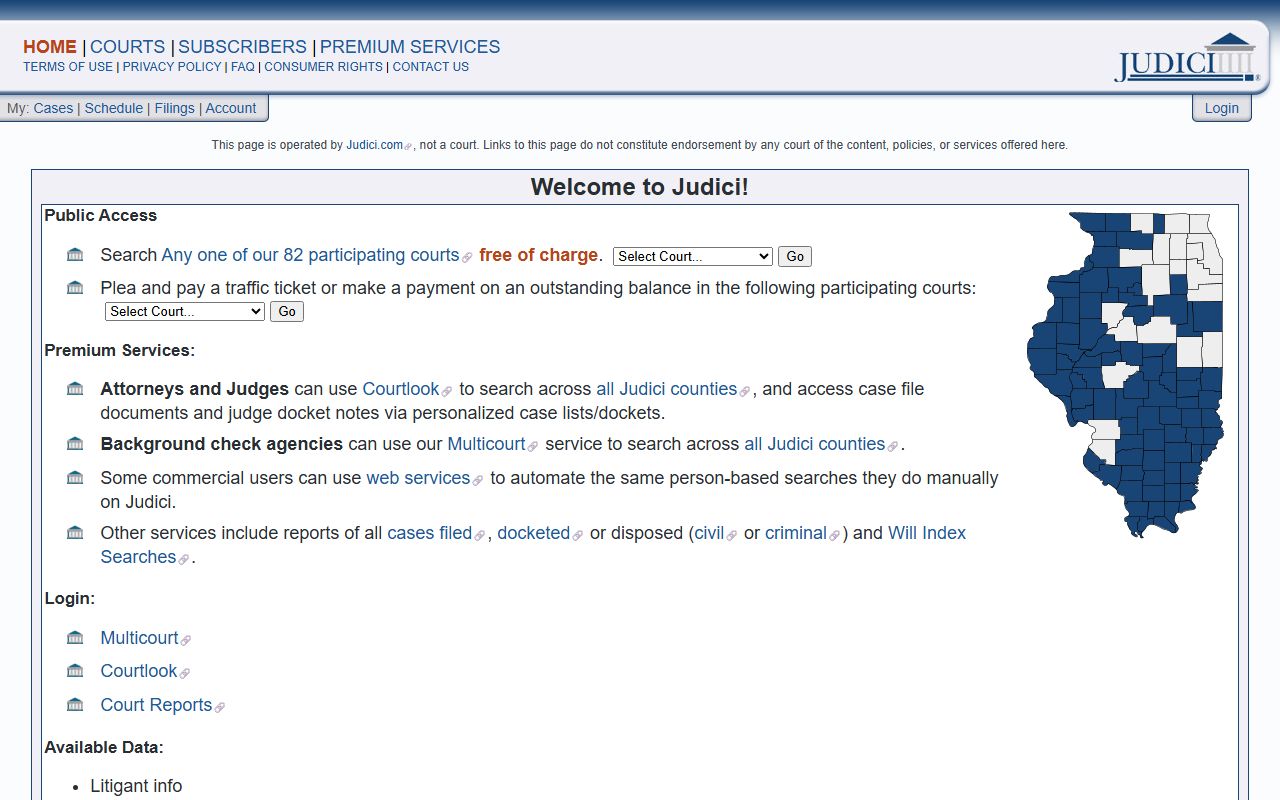
The portal matters because Shelby County court records after a jail arrest are usually read by case number, defendant name, charge list, hearing date, and disposition, not by jail housing status.
| Field Label | Type | Required | Notes |
|---|---|---|---|
| Court | Dropdown or URL parameter | Yes | The Shelby County court parameter inspected was IL087025J. |
| Case Number | Text | No | Best path when the number is known from a ticket, notice, or clerk record. |
| Litigant Name | Text | No | Use defendant or party name. Exact live labels were blocked by captcha. |
| Filed Date or Case Type | Filter | Unspecified | Judici commonly uses filters, but Shelby-specific labels were not fully visible. |
| Search | Button | n/a | Runs the search after portal checks, captcha, or terms prompts. |
Court Charges After Jail Arrest
After a Shelby County arrest, the State's Attorney reviews law-enforcement reports, booking facts, witness information, and any warrant or citation material. The prosecutor's decision is what turns a jail event into a formal criminal case. Shelby County State's Attorney Ruth Woolery is listed at 301 E. Main Street, Shelbyville, Illinois 62565, with office phone 217-774-5511 and email statesattorney@shelbycounty-il.gov.
Formal charges can appear through different charging papers. A complaint may start a misdemeanor or early felony matter. An information is filed by the prosecutor. An indictment follows grand-jury action and is more common in serious felony cases. The key point for court records after an arrest is that booking language can be rough, early, or incomplete, while the filed court record is the better source for the charge that the court will track.
| Charging Document | Filed By | Common Use | What to Check |
|---|---|---|---|
| Complaint | Officer or prosecutor | Many misdemeanors and initial criminal filings | Charge wording, filing date, sworn facts, and first hearing. |
| Information | State's Attorney | Many felony prosecutions after review | Filed counts, offense class, amendments, and plea or trial settings. |
| Indictment | Grand jury | Serious felony cases or cases presented to a grand jury | Count list, indictment date, and later amendments or dismissals. |
Shelby County Arrest Charge Status
Charge status is the part of the court record that changes most after arrest. A charge can be pending while the case is active, amended after review, reduced as part of negotiation, dismissed by the court, or resolved by plea, trial, supervision, or sentence. Illinois supervision is a distinct disposition that may avoid a conviction if successfully completed, depending on the case. A warrant entry, remand entry, or detention order can also appear on the docket and affect custody even before the case is final.
| Status | Meaning in Court Records | Custody Impact |
|---|---|---|
| Pending | The filed case or count has not reached final disposition. | The person may be held or released under court conditions. |
| Amended | The charge was changed from an earlier filed version. | Release conditions may stay the same or be reviewed. |
| Reduced | The charge changed to a lesser offense. | Can affect sentencing range and case posture. |
| Dismissed | The count ended without conviction on that charge. | Other counts or holds may still control release. |
| Warrant Issued | The court ordered arrest, often for failure to appear or noncompliance. | Can lead to a new booking at Shelby County Jail. |
| Sentenced to IDOC | The person received a state-prison sentence. | Use IDOC after transfer from county jail. |
Court Release After Arrest
Illinois pretrial release changed under the SAFE-T Act and Pretrial Fairness Act framework. Current Shelby County cases should be described in terms of pretrial release, court-ordered conditions, and detention hearings rather than old cash-bail boilerplate. The court decides release or detention. Jail staff carry out the custody order and release paperwork. For exact case status, use the jail phone line at 217-774-3941, the Circuit Clerk at 217-774-4212, the court record on Judici, or the attorney of record.
Release can be delayed by a separate warrant, another county hold, a state supervision matter, a federal issue, or an immigration detainer. The 2024 IDOC inspection says Shelby County Jail is not contracted to hold for other entities, but that does not mean a person can never be booked locally on a warrant or held pending transfer. Court records, jail contact, and counsel are all useful because each system answers a different part of the release question.
| Release Issue | Plain Meaning | Where to Verify |
|---|---|---|
| Release on recognizance or conditions | The court allows release if the person follows listed terms. | Judici, Circuit Clerk, attorney, or jail release desk. |
| Detention order | The court orders continued custody after the required hearing. | Court docket and attorney of record. |
| Warrant hold | A separate warrant may block release on the Shelby County case. | Court records, jail routing, or counsel. |
| Out-of-county hold | Another agency may request custody or pickup. | Jail and originating court or agency. |
| IDOC or parole matter | State corrections status may affect release. | IDOC and court records. |
Shelby County Court Warrants
No official Shelby County Sheriff's active-warrant search was located in the inspected sheriff pages. That limits public warrant lookup. A bench warrant may appear in court records after a missed hearing, unpaid obligation, probation issue, or other noncompliance. An arrest warrant can lead to booking at Shelby County Jail, and a fugitive or out-of-county warrant can make Shelby County only the holding location while another court owns the warrant record.
Use Judici for Shelby County court case entries, call the Circuit Clerk for public case-record questions, and contact counsel if a person believes a warrant exists. The sheriff phone can route immediate custody questions, but the research did not locate a public policy promising warrant confirmation by phone. Avoid unofficial active-warrant sites. They may be incomplete, stale, or unrelated to the actual court record.
Important: A warrant question can affect arrest risk, so court or attorney contact is safer than relying on unofficial search pages.
Charges vs Convictions
A Shelby County arrest charge is an accusation or booking basis. A court conviction is a final judgment after plea, verdict, or other qualifying disposition. That distinction matters for background checks, employment questions, sealing, and personal record review. Public court records may show both charges and outcomes, but the reader must check the disposition for each count instead of treating every filed charge as a conviction.
| Charge | Conviction | |
|---|---|---|
| Stage | Allegation after arrest or filing | Final judgment or qualifying plea outcome |
| Proof Level | Begins with probable cause or filed accusation | Requires plea, verdict, or judgment under court rules |
| Can Change | May be amended, reduced, added, or dismissed | Can be appealed, vacated, sealed, or expunged only through legal process |
| Best Source | Judici, clerk filings, charging document | Disposition, sentence entry, certified court copy |
Restricted Court Records After Arrest
The Shelby County Circuit Clerk page states that court records and files are public except juvenile records, adoption records, and records impounded or sealed by statute or court order. The same page says the Clerk of the Circuit Court is not subject to Illinois FOIA because the judicial branch is outside FOIA's public-body definition. That means court access is handled through court rules and clerk procedure, while sheriff arrest reports and jail records follow sheriff public-record channels.
Illinois 5 ILCS 140/2.15 addresses arrest reports and criminal-history information held by law-enforcement agencies. Illinois 20 ILCS 2630/5.2 governs expungement and sealing for eligible arrest and criminal records. A sealed record is not the same as an expunged record, and neither result should be assumed just because a charge was dismissed.
| Sealed | Expunged | |
|---|---|---|
| Public Visibility | Hidden from most public access after court order | Removed or treated as not having occurred under the statute and order |
| Law Enforcement Access | May remain available for limited government uses | More limited, subject to statutory exceptions |
| How It Happens | Petition and court order when eligible | Petition and court order when eligible |
| What to Check | Disposition, eligibility, and sealed-record order | Expungement order and agency compliance steps |
Court Records and Background Checks
Casual court-record lookup is not the same as a regulated background check. A Judici result, clerk copy, arrest report, or jail record may be useful for personal review, case tracking, or family custody questions, but employment, housing, credit, insurance, and similar screening uses can trigger federal and state compliance duties. If a certified record is needed, request it through the Circuit Clerk rather than relying on a screenshot or third-party summary.
Important: This resource is not a consumer reporting agency and must not be used for FCRA-covered screening.